


The Choice Nobody Sees
A car drove through my garden wall at 1am. I slept through it.
A few days from my 60th birthday, working early with the TGE team in Australia, I looked out of the den that morning and saw nothing out of place. TGE was going well. I was, all in all, very happy.
That wasn’t going to last long. It was my wife, driving out a little later, who texted me. “Car in the garden.”
I was on a Teams call. I read the message, took it in, and kept working. I’m not proud of that, but it’s the truth. You absorb the news, file it as a problem for later, and carry on. By 10am I’d finished the call and went out to look properly.
The car was on its side. Twenty feet into the garden. Walls demolished, fencing flattened, a young man’s vehicle wedged at an angle that didn’t look possible. Two police officers were waiting for me. They explained that the driver had lost control at 1am the previous morning, almost a full day earlier. He was young. He’d walked away. The car had not.
I’m a deep sleeper, but I still don’t know how we slept through it.
Then came the part you already know if you’ve ever had to deal with an insurer. The reference number. The forms. The photographs. The quotes. The slow, grinding administrative slog of putting a thing back together that someone else broke. You set aside an afternoon, then a week, then you stop counting.
That’s where the story should have ended for the rest of the week. Aggravation, paperwork, a quietly ruined birthday weekend.
It didn’t.
Mathew
Hiscox put me through to a man called Mathew. Within the first two minutes of the call, Mathew had given me his personal email address and his direct number. “I’m your point of contact,” he said. “Anything you need, fastest way is straight to me.”
That alone was unusual enough to register. Most companies, in 2026, would have given me a ticket number and an inbox monitored by twelve people. Mathew gave me Mathew.
We worked through the details. Toward the end of the call I mentioned, half-laughing, that something like this wasn’t going to dampen my plans for the weekend. He picked up on it. Asked what was happening. I told him. Big birthday, family coming over, the works. We had a laugh about a car in the garden not being the gift I’d asked for. We rang off. I added his number to my phone and got on with the rest of the day.
The next morning, a parcel arrived at the house from Selfridges. I assumed a friend had sent something through and left it unopened on the side. I’m not the kind of person who tears into a box. I was busy. It would keep.
Birthday morning
The whole family arrived. Diane, the kids, balloons taller than the doorframe, cake, the works. At some point in the morning I remembered the Selfridges box and brought it in, curious which friend had thought of me.
It wasn’t from a friend.
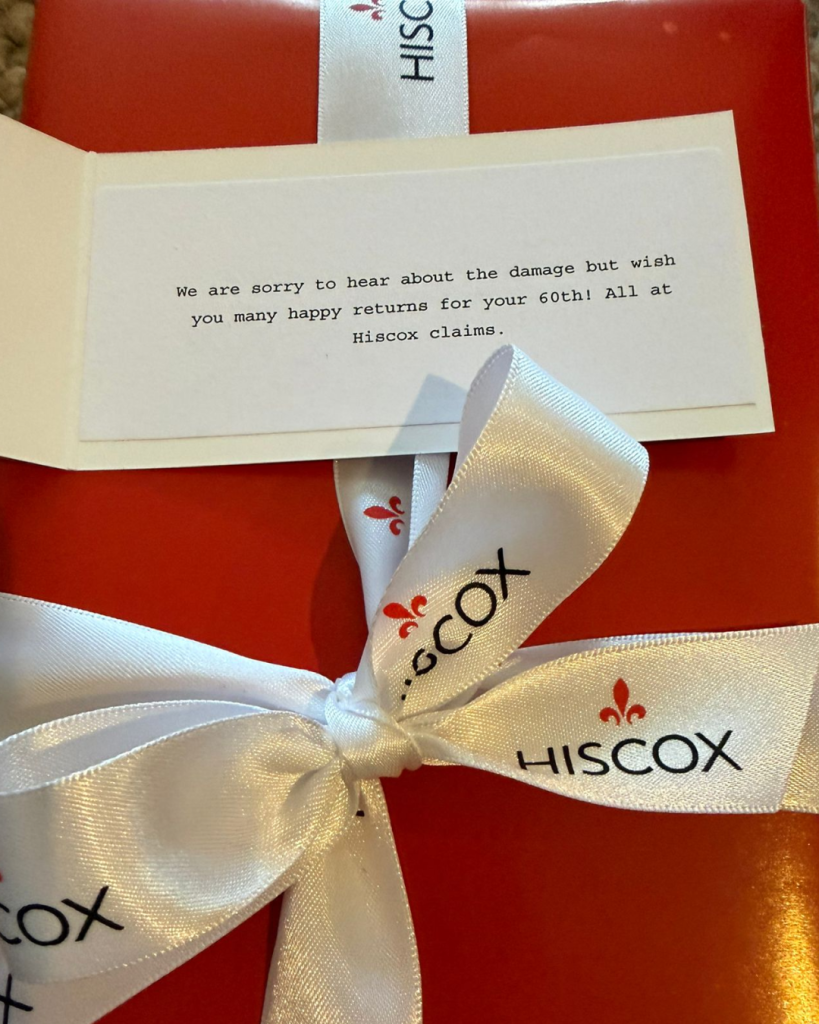
It was from Hiscox. Their wrapping. A printed note from “all at Hiscox claims.” A bottle of champagne. A short, warm message wishing me a happy 60th.
I have been in business for thirty-two years. I have run companies with millions of customers and tens of thousands of staff. I have seen every kind of customer service strategy, gimmick, framework and policy that exists. I have authorised most of them. And I sat in my kitchen on my birthday morning, looking at a bottle of Veuve Clicquot from my insurance company, and I knew exactly what I was looking at.
It wasn’t a gift. It was a choice.
The TNTs
Here’s what I keep coming back to.
The card. The timing. Someone in the claims team — not Mathew alone, but a process somebody had built behind him — noticing the conversation about the weekend, holding onto the date, and acting on it three days later before my birthday actually arrived.
In customer service circles there’s a term for this. TNTs. Tiny Noticeable Things. The little, unexpected gestures that cost almost nothing but leave the longest-lasting impressions. The handwritten note. The remembered name. The follow-up call nobody booked in. The thing somebody did because they could, not because they had to. We know all about them. Thousands of businesses don’t.
The Hiscox card — printed on a card from “all at Hiscox claims,” timed to arrive the day before my birthday — was the TNT. The chammy was just the scale of it. A long-standing customer hitting a milestone birthday, so the team chose to make it champagne. Could just as easily have been a small cake or a card on its own. The act would have been the same. The fact that it was Veuve Clicquot didn’t make it world class. The fact that someone chose to do it at all made it world class.
That’s where world-class customer service actually lives. Not in your call-handling times, your NPS scores, your satisfaction surveys, or your training decks. In the small decisions your people make in the gaps your processes don’t cover. In the TNTs.
I have spent three decades trying to engineer cultures where people make those choices. I will tell you for nothing: it is the single hardest thing in business. TNTs cannot be mandated. They cannot be incentivised through pay. They cannot be installed by consultancy. The moment you try to systematise them, they become the opposite of themselves — a forced gesture stops being a TNT and starts being a script. You can only hire for it, talk about it constantly, model it from the top, and protect the people who do it from the parts of the organisation that would talk them out of it.
When I was running DPD, I used to say that the moment of truth in any service business is not the part the customer sees. It’s the moment your driver, your handler, your call-centre agent, your engineer is standing in a corridor on their own, with nobody watching, and they decide whether to do the small thing nobody asked for. Multiply that decision by the number of times it happens in a week, and that is your culture. That is your brand. That is the actual thing you are selling, regardless of what the website says.
Three things to take from this
First, I’d encourage every leader reading this to phone their own customer service line this week. Not as a leader. As a customer. Listen to what happens. Listen to what your team has been told to say, and listen for the small moments where they could choose to do more, or less. That gap, between policy and instinct, is where you’ll find your real culture.
Second, the next time someone in your business pitches a customer experience programme, ask them one question. Tell me about a specific moment last quarter where one of our people did something for a customer that wasn’t on the script. If they can’t answer in fifteen seconds, you don’t have a culture problem. You have a leadership problem. You’re rewarding the wrong things.
Third, if you ever need household insurance, I can recommend Hiscox.
To Mathew
Thank you. The car will be sorted in time. Walls will be rebuilt, fencing replaced, paperwork filed and forgotten. None of that I will remember in a year.
The note, the wrapping, the Chammy, the message from a team I’d never met. That, I will remember for as long as I’m in business.
You did the thing nobody told you to do. That’s the only thing that matters.
Keep doing what you’re doing.